










































































































































































HomeBlog & GuidesGuidesElectrical
Oscillating Tool Blades: Metal vs Wood, Universal Fit
Which oscillating blade to grab for nails, EMT, PVC, drywall or grout, how deep the 1-3/8 and 1-3/4 in. blades really plunge, and which multi-tools they fit.
Quick answer: Match the blade to the hardest thing it will touch. For nails, screws, EMT or copper, use a metal blade such as ITM OM-2B ($11.41 a blade in a 10-pack). For clean wood, PVC or ABS, use OW-2B ($7.38 a blade). Use WDR-3 for drywall and OCG-2 for grout. Pick 1-3/8 in. for tight spots and 1-3/4 in. to plunge deeper: 2-1/4 in. instead of 1-1/2 in. All are open shank and fit most multi-tools that are not Starlock-only.
Which oscillating blades do I grab for the cut in front of me?
Grab the oscillating tool blades for the hardest material the teeth will touch, not the softest. A stud with one hidden nail is a metal cut. A PVC drain with nothing behind it is a plastic cut. Answer three questions: what is in the cut, how deep it goes, and how many blades you will use this month. The picker below walks through them.
The job |
Blade |
Width × plunge |
SKU |
Pack |
Per blade |
|---|---|---|---|---|---|
Cut a box opening in drywall |
Drywall blade |
3-1/2 in. wide |
10 for $82.10 |
$8.21 |
|
Trim a PVC or ABS drain, or a closet flange, flush to the floor |
Wood & plastic, Japanese-style teeth |
1-3/8 × 1-1/2 in. |
10 for $73.77 |
$7.38 |
|
Plunge through a 2x plate or clean framing |
Wood & plastic, Japanese-style teeth |
1-3/4 × 2-1/4 in. |
10 for $82.71 |
$8.27 |
|
Cut EMT, copper stub-outs, nails, screws, sheet metal |
Metal, titanium-coated bi-metal teeth |
1-3/8 × 1-1/2 in. |
5 for $60.21 / 10 for $114.13 |
$12.04 / $11.41 |
|
Notch a stud or plate that may hide nails, or cut through a 2x plus drywall |
Metal, titanium-coated bi-metal teeth |
1-3/4 × 2-1/4 in. |
5 for $69.85 / 10 for $132.42 |
$13.97 / $13.24 |
|
Rake out grout around a valve, tub or cracked tile |
Carbide grit |
3-1/2 in. wide |
10 for $135.17 |
$13.52 |
|
Hardened bolts, threaded rod, stainless, rigid conduit |
Not an oscillating job for us; use a reciprocating saw or a cut-off wheel |
— |
— |
— |
— |
All ITM, open shank, with inch and centimeter depth marks. Prices from our product database on Oct 26, 2026.
Will an oscillating blade cut metal?
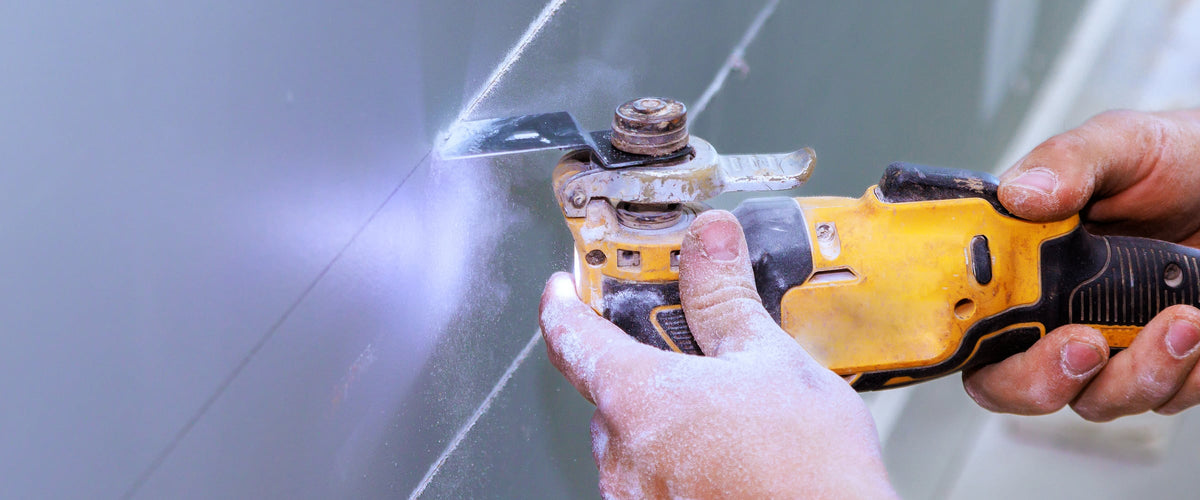
An oscillating blade cuts thin and soft metal well: EMT, copper tube, nails, drywall screws and sheet metal. That is the work electricians and plumbers hand it most, usually where nothing else fits, such as a stub-out tight to a wall or a nail sitting under a plate.
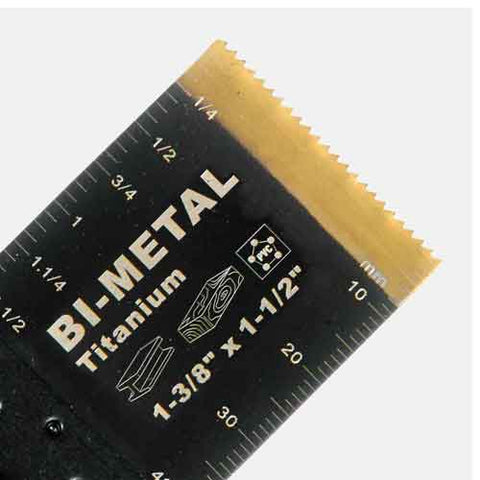
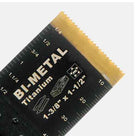
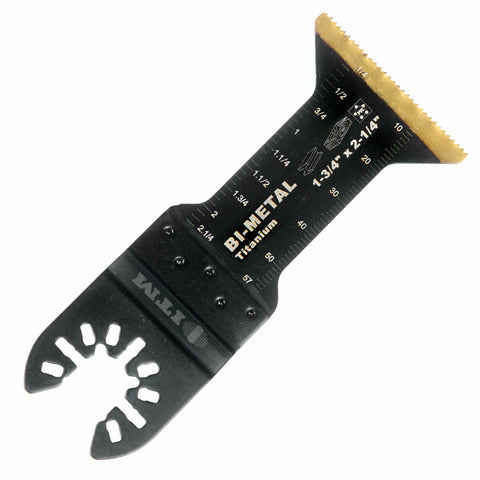
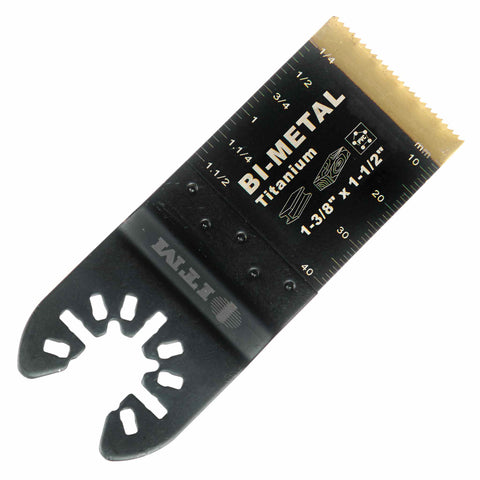
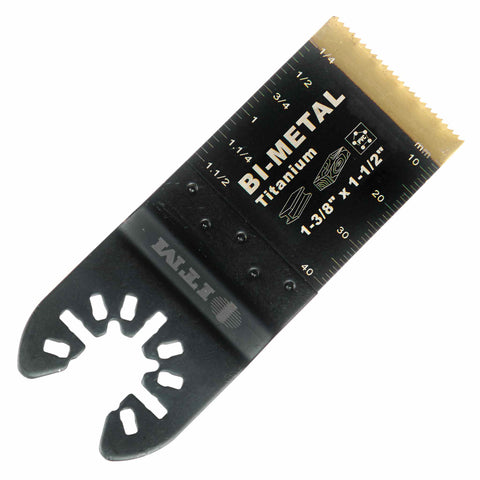
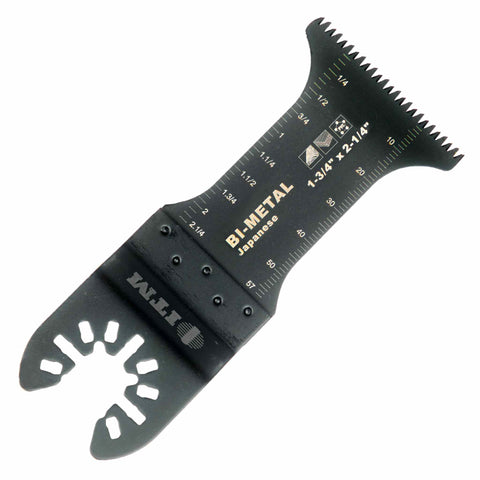
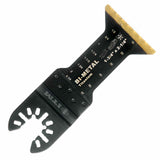
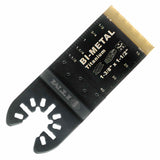
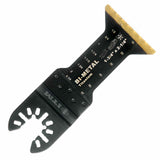
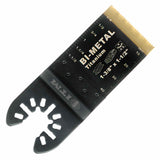
Use a metal blade, not a wood blade. Our OM-2A and OM-3A blades have bi-metal teeth with a titanium coating, and they are rated for metal, nails and wood. On metal, run the tool at a middle speed, let the teeth do the cutting and sweep the blade a little side to side so the same few teeth are not doing all the work. Heat dulls a blade faster than hard material does.
Leave thick, hard steel to other tools. A hardened bolt, a run of threaded rod or rigid conduit wears out bi-metal oscillating teeth quickly. A reciprocating saw blade or a thin cut-off wheel does that work faster and for less per cut. See our reciprocating saw blade guide and our cut-off wheel guide.
Do I need the 1-3/8 in. or the 1-3/4 in. blade?
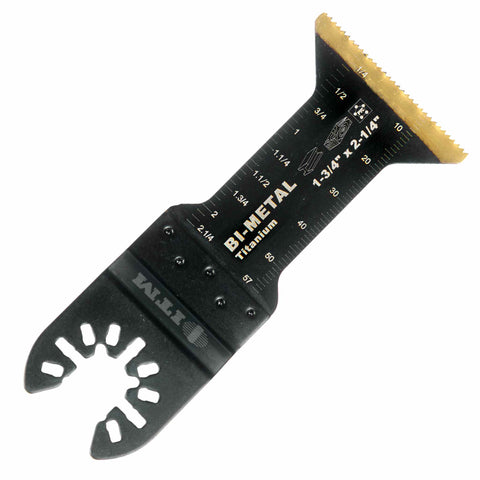
Choose by depth first, then by room to work. On our blades the width also sets the plunge: the 1-3/8 in. blades cut 1-1/2 in. deep, and the 1-3/4 in. blades cut 2-1/4 in. deep. Some general answers online say both widths plunge about 1-5/8 to 2 in. Ours do not, so check the plunge number on the package.
A 2x board is 1-1/2 in. thick, so the narrow blade only just gets through it, with no depth left over. If the cut is a plate with 5/8 in. drywall on it (2-1/8 in.), only the wide blade goes through in one plunge. The narrow blade is stiffer and fits into tighter spots, such as between a pipe and a wall.
What you are plunging through |
Thickness |
1-3/8 in. blade (1-1/2 in. plunge) |
1-3/4 in. blade (2-1/4 in. plunge) |
|---|---|---|---|
5/8 in. drywall |
5/8 in. |
Yes |
Yes |
3/4 in. plywood subfloor |
3/4 in. |
Yes |
Yes |
2x plate or stud, flat |
1-1/2 in. |
Just, with no margin |
Yes |
2x plate plus 5/8 in. drywall |
2-1/8 in. |
No |
Yes |
Are oscillating tool blades universal?
Most are, but not all of them. An open-shank blade, also called open-back or universal fit, has a slot at the back of the mount. It slides onto the pin-and-clamp mounts most multi-tools use, often without taking the clamp off. Tools built only for Bosch and Fein's Starlock mounts (Starlock, StarlockPlus, StarlockMax) take Starlock blades and will not hold an open-shank blade without an adapter.
Every oscillating blade we sell is open shank. Pick your tool below to check the fit, and if you are unsure, look at the blade mount: Starlock tools have a three-dimensional star-shaped mount rather than a flat ring of pins.
Multi-tool mount |
Takes our open-shank blades? |
|---|---|
DeWalt (quick-change lever) |
Yes |
Milwaukee M12 and M18 (OPEN-LOK lever or bolt) |
Yes |
Makita, Ryobi, Ridgid and most other pin-and-clamp tools |
Yes |
Bosch and Fein tools with a Starlock-only mount |
No, not without an adapter |
Wood blade or metal blade when there might be nails?
Use the metal blade whenever you might hit a fastener. Blades are marked by tooth material. HCS (high-carbon steel) is cheap and cuts clean wood fast, but its teeth flatten on the first nail. BIM (bi-metal) blades have hardened teeth on a flexible body, so they survive metal. Carbide is harder again and is used for grout and heavy metal.
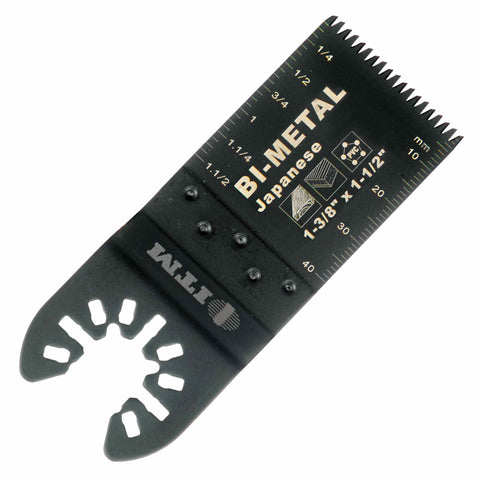
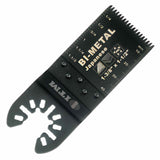
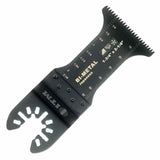
ITM marks both of our blade families as bi-metal. The wood blades (OW-2B, OW-3B) use Japanese-style teeth: fine, sharp and quick in wood, PVC and ABS. They are not built to cut steel. The metal blades (OM-2B, OM-3B) have titanium-coated teeth for metal, nails and wood. On a remodel cut through old framing, use the metal blade and keep the wood blade for new, clean stock.
Which blade cuts drywall, and which removes grout?
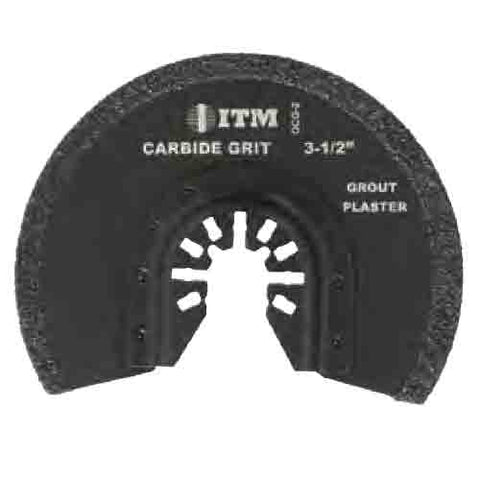
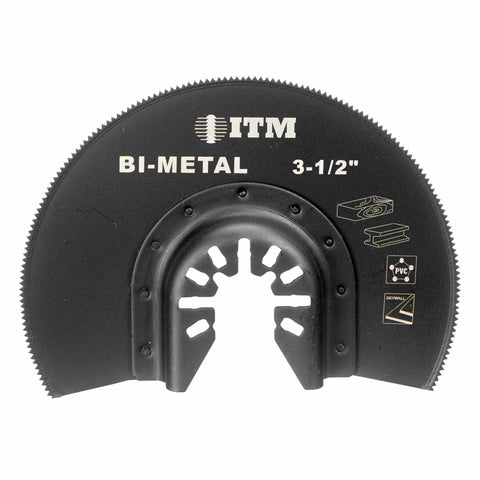
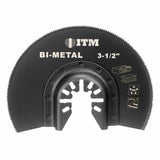
Use the wide WDR-3 for drywall and the carbide-grit OCG-2 for grout. The 3-1/2 in. drywall blade cuts a long, straight line in each plunge, which suits large openings and access panels. For a single-gang box, a 1-3/8 in. wood blade is narrower than the box sides, so the corners stay clean. Either way, plunge shallow when you do not know what is behind the wall.
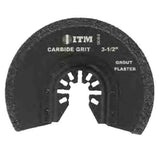
The grout blade has no teeth. Carbide grit grinds cement grout out of the joint without chipping the tile edge, which helps when you open a wall around a shower valve or swap one cracked tile. Diamond-grit blades last longer in epoxy grout and large jobs. We do not stock one now. If you are drilling the tile afterward, see how to drill through tile without cracking it.
Is the 10-pack worth it?
For metal blades, the 10-pack saves about 5% a blade: 63 cents on the 1-3/8 in. blade and 73 cents on the 1-3/4 in. blade. The wood, drywall and grout blades come only in 10-packs. Compare blades by price per blade, not per pack, and keep a pack of both the metal and the wood blade on the truck so nobody puts a fine-tooth blade into a nail.
"Buy for the nail, not the wood. What’s in the cut, how deep it goes and how often you cut: answer those three in our picker and you’ll get the right blade the first time.”
— David Castro, President, Eldorado Tools
Which oscillating blades do we carry?
We carry eight ITM oscillating blades, all open shank, in four families. All of them are in our oscillating blades collection.
SKU |
Cuts |
Teeth |
Width × plunge |
Pack |
Price |
Per blade |
|---|---|---|---|---|---|---|
Metal, nails, wood |
Bi-metal, titanium-coated |
1-3/8 × 1-1/2 in. |
5 |
$60.21 |
$12.04 |
|
Metal, nails, wood |
Bi-metal, titanium-coated |
1-3/8 × 1-1/2 in. |
10 |
$114.13 |
$11.41 |
|
Metal, nails, wood |
Bi-metal, titanium-coated |
1-3/4 × 2-1/4 in. |
5 |
$69.85 |
$13.97 |
|
Metal, nails, wood |
Bi-metal, titanium-coated |
1-3/4 × 2-1/4 in. |
10 |
$132.42 |
$13.24 |
|
Wood, plastic |
Bi-metal, Japanese-style |
1-3/8 × 1-1/2 in. |
10 |
$73.77 |
$7.38 |
|
Wood, plastic |
Bi-metal, Japanese-style |
1-3/4 × 2-1/4 in. |
10 |
$82.71 |
$8.27 |
|
Drywall |
Drywall |
3-1/2 in. wide |
10 |
$82.10 |
$8.21 |
|
Grout |
Carbide grit |
3-1/2 in. wide |
10 |
$135.17 |
$13.52 |
Prices from our product database on Oct 26, 2026.
FAQ
What does HCS mean on a multi-tool blade?
HCS means high-carbon steel. HCS blades cut clean wood, plastic and drywall well and cost the least, but they dull fast on nails. BIM means bi-metal, which survives metal and fasteners.
Can I cut a PVC drain pipe flush to the floor with an oscillating tool?
Yes. Lay a 1-3/8 in. wood and plastic blade such as OW-2B flat on the floor and plunge into the pipe at a middle speed. If the plastic starts to melt, slow down rather than push harder.
Will open-shank blades fit a Milwaukee M18 or a DeWalt multi-tool?
Yes. Both tools take open-shank, universal-fit blades. Only Starlock-only tools need Starlock blades.
Can you sharpen an oscillating blade?
It is not worth it. The teeth are small and set, and a new blade costs $7 to $14. Replace it when it starts to burn the wood or stops pulling itself into the cut.