


































HomeBlog & GuidesGuidesElectrical
Carbide Sawzall Blade vs Bi-Metal: When Carbide Pays Back
When a carbide sawzall blade pays for itself against bi-metal demolition blades, with real prices, cast iron blade lengths and picks for each trade.
Quick answer: A carbide sawzall blade pays for itself on metal that eats bi-metal teeth: cast iron pipe, stainless and thick steel pier tube. Our 9 in. carbide blade, the CT9, costs $21.84. That's about three bi-metal demolition blades (DM910, $7.13). So if one carbide blade lasts longer than three bi-metal blades on your job, carbide is the cheaper buy. For nail-embedded wood, stay with a bi-metal demolition blade.
Every crew has the same argument in the truck. One hand buys the cheap blades by the box and burns through them. The other swears by carbide and won't touch anything else. They're both right, on different jobs.
A carbide blade costs more up front. It only earns that back when the material would have killed a cheaper blade fast. On a cast iron stack or a steel pier, that happens in a few cuts. In old framing full of nails, it never happens, and the cheap blade wins.
This guide does the math with our real prices, so you can see where the line falls on your job. It's written for plumbers cutting out cast iron, electricians cutting strut and rod, and foundation crews trimming pier tube and tearing out forms. People also call these blades sawzall blades, recip blades or reciprocating saw blades. All of ours are made in the USA by ITM and fit any saw with a 1/2 in. universal shank: Milwaukee, DeWalt, Makita, Bosch, Ryobi and the rest. For picking a blade for any other material, start with our guide to choosing reciprocating saw blades.
Carbide vs bi-metal demolition blades: what's the difference?
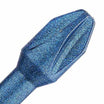
A carbide sawzall blade has small tips of tungsten carbide fixed to each tooth. Carbide is much harder than steel and holds its edge in hard, abrasive metal. A bi-metal demolition blade has high-speed steel teeth welded to a thick, springy steel body. The teeth wear faster, but the blade takes a beating and bends instead of breaking.
| Trait | Carbide (MaxMetal CT6, CT9) | Bi-metal demolition (DM606 to DM1210) |
|---|---|---|
| Teeth | Carbide tips, 8 per inch | Bi-metal, 8% cobalt, 6 or 10 per inch |
| Body | 1 in. tall, .050 in. thick, rigid | 7/8 in. tall, .062 in. thick, springy |
| Lengths we sell | 6 and 9 in. | 6, 9 and 12 in. |
| Made for | Cast iron, stainless, mild steel, aluminum, sheet metal (ITM's list) | Tear-out: wood with nails, mixed wood and metal |
| Price per blade | $14.69 (6 in.), $21.84 (9 in.) | $5.68 (6 in.), $7.13 (9 in.), $9.35 (12 in.) |
| Sold in | Packs of 5, or boxes of 25 | Packs of 3 (minimum 2 packs), or boxes of 25 |
| Where it loses | Nails in wood, prying, twisting in a bind: carbide tips can chip off | Cast iron and stainless: teeth dull in a few cuts |
Verdict: Carbide for cast iron, stainless and thick steel. Bi-metal demolition for wood, nails and mixed tear-out.
Prices from eldoradotools.com on Nov 19, 2026. Specs from ITM's 2026 catalog, pp. 59 and 60.
Three different blades all get called "carbide"
Search for a carbide sawzall blade and you'll see three kinds of blade mixed together. They don't do the same job.
| Blade type | Cutting edge | Made for | Do we sell it? |
|---|---|---|---|
| Carbide-tooth metal blade | Carbide tips, about 8 teeth per inch | Cast iron, stainless, thick steel | Yes: MaxMetal CT6 and CT9 |
| Carbide-tooth wood or demolition blade | Carbide tips, about 3 to 6 teeth per inch | Nail-embedded wood, pruning | No. Our demolition blades are bi-metal. |
| Carbide grit blade | No teeth, a strip of carbide grit | Tile, cement board, fiberglass | No |
This guide is about the first kind against our bi-metal blades. If you're cutting tile or cement board, a grit blade is a different tool for a different job.
When does a carbide sawzall blade pay for itself?
A carbide blade pays for itself once it makes more cuts than the bi-metal blades you'd buy for the same money. Divide the carbide price by the bi-metal price, and that's how many bi-metal blades it has to beat.
| Carbide blade | Compared with | Carbide per blade | Bi-metal per blade | Carbide must last longer than |
|---|---|---|---|---|
| CT6, 6 in. | DM610 demolition, 6 in. | $14.69 | $5.68 | 2.6 bi-metal blades |
| CT6, 6 in. | HM614 Heavy-Metal, 6 in. | $14.69 | $4.15 | 3.5 bi-metal blades |
| CT9, 9 in. | DM910 demolition, 9 in. | $21.84 | $7.13 | 3.1 bi-metal blades |
| CT9, 9 in. | HM914 Heavy-Metal, 9 in. | $21.84 | $5.56 | 3.9 bi-metal blades |
| CT9-B, box of 25 | DM910-B, box of 25 | $20.69 | $6.80 | 3.0 bi-metal blades |
Prices from eldoradotools.com on Nov 19, 2026, per blade. Packs: CT6 and CT9 $73.45 and $109.22 for 5; DM610 and DM910 $17.05 and $21.39 for 3; HM614 and HM914 $20.76 and $27.78 for 5; CT9-B $517.35 and DM910-B $170.07 for 25.
That's the blade cost alone. The bigger cost on most jobs is time. Every dull blade means a slower cut, a stop, a blade change and sometimes a trip back to the truck. On a cast iron tear-out, the carbide blade usually wins on time long before it wins on blade cost.
"Carbide recips are noticeably smoother and less violent. I get upwards of three dozen heavy-duty cuts out of one blade. They last a lot longer than anything without carbide."
David Castro, President, Eldorado Tools
At three dozen cuts, a CT9 works out to about 61 cents a cut. For a DM910 to match that, it would have to make about 12 of the same cuts.
Cost per cut: find your blade's life on the chart
You know roughly how many cuts you get from a blade. Find that number on the bottom of the chart and read across to the cost of each cut.
| Cuts one blade makes | CT9 carbide ($ per cut) | DM910 demolition ($ per cut) | HM914 Heavy-Metal ($ per cut) |
|---|---|---|---|
| 1 | 21.84 | 7.13 | 5.56 |
| 2 | 10.92 | 3.57 | 2.78 |
| 3 | 7.28 | 2.38 | 1.85 |
| 4 | 5.46 | 1.78 | 1.39 |
| 6 | 3.64 | 1.19 | 0.93 |
| 8 | 2.73 | 0.89 | 0.70 |
| 12 | 1.82 | 0.59 | 0.46 |
| 18 | 1.21 | 0.40 | 0.31 |
| 24 | 0.91 | 0.30 | 0.23 |
| 36 | 0.61 | 0.20 | 0.15 |
How to read the chart: the bottom axis is how many cuts one blade lasts; the side axis is what each cut costs in blade, in dollars. Pick a point on each line for how long that blade really lasts in your material, then compare the heights. What it means for you: a CT9 that makes 12 cuts costs $1.82 a cut; a DM910 that dies after 3 cuts costs $2.38 a cut. In cast iron, carbide is the cheaper blade.
What sawzall blade cuts cast iron pipe, and how long should it be?
Use a carbide blade at least 3 in. longer than the outside of the pipe. The extra length keeps the tip past the far side of the pipe through the whole stroke, so it doesn't jam into the pipe wall. That means the 6 in. CT6 for 2 in. pipe and smaller, and the 9 in. CT9 for 3 and 4 in. pipe.
| Cast iron pipe | Outside diameter (in.) | Blade needs to be at least (in.) | Our carbide blade |
|---|---|---|---|
| 1-1/2 in. no-hub | 1.90 | 4.9 | CT6, 6 in. |
| 2 in. no-hub | 2.35 | 5.4 | CT6, 6 in. |
| 3 in. no-hub | 3.35 | 6.4 | CT9, 9 in. |
| 4 in. service weight, barrel | 4.30 | 7.3 | CT9, 9 in. |
| 4 in. no-hub | 4.38 | 7.4 | CT9, 9 in. |
| 4 in. service weight, at the hub | 4.94 | 7.9 | CT9, 9 in. |
| 6 in. no-hub or service weight | 6.30 | 9.3 | None. Our longest carbide blade is 9 in. Call us. |
Outside diameters: no-hub from CISPI 301 Table 1; service weight from Charlotte Pipe's service-weight submittal (ASTM A74). The 3 in. rule is the same one our blade guide uses.
A bi-metal blade will cut cast iron. It just won't do it for long. The pipe is hard and gritty, and steel teeth dull fast in it. If you only have one cut to make, a Heavy-Metal blade such as the HM910 will get you through it. If you're taking out a stack, buy carbide.
The usual way to cut a cast iron stack in a wall: hold the saw level and square to the pipe, with the shoe pressed against it. A sawzall throws no sparks, which is why it's the usual tool indoors over a grinder. Support the pipe above and below the cut first. A section of cast iron that drops when the cut finishes can pinch the blade and snap the carbide tips, or hurt somebody.
Which blade for plumbing, electrical and foundation work?
Match the blade to the material, not the trade. Carbide earns its price on cast iron, stainless and heavy steel. Everything else is cheaper with bi-metal.
| Trade | The cut | Buy | Why |
|---|---|---|---|
| Plumbing | Cast iron soil pipe, 2 in. and under | CT6 carbide, 6 in. | Clears 2.35 in. pipe with room to spare |
| Plumbing | Cast iron soil pipe, 3 and 4 in. | CT9 carbide, 9 in. | Reaches past a 4 in. hub (4.94 in.) |
| Plumbing | PVC and ABS drain pipe | M610 metal blade, 10 teeth | Plastic doesn't wear teeth; carbide is wasted money |
| Electrical | Steel strut channel, threaded rod, EMT | M618 or M624 metal blade | Thin walls need fine teeth; bi-metal is cheaper per cut |
| Electrical | Stainless strut and stainless threaded rod | CT6 carbide, 6 in. | ITM rates MaxMetal for stainless; bi-metal teeth dull fast in it |
| Foundation | 2-7/8 in. pier tube (most are .165 in. wall) | CT6 carbide, 6 in. | Needs a blade of 5.9 in. or more; many cuts per job |
| Foundation | 3-1/2 in. pier tube or sleeve | CT9 carbide, 9 in. | Needs a blade of 6.5 in. or more |
| Foundation | A few cuts in rebar | HM910 Heavy-Metal, 10 teeth | Cheaper for a handful of cuts; switch to CT9 for a day of it |
| Foundation | Forms, sill plates, framing with nails | DM906 or DM1206 demolition | Nails chip carbide tips; the thick bi-metal body takes the abuse |
| Pier tube | Outside diameter (in.) | Blade needs to be at least (in.) | Our carbide blade |
|---|---|---|---|
| 2-7/8 in. pier tube | 2.875 | 5.9 | CT6, 6 in. |
| 3-1/2 in. pier tube or sleeve | 3.50 | 6.5 | CT9, 9 in. |
Pier tube size: Supportworks Model 288 and Hubbell Atlas pier specs list 2-7/8 in. OD by .165 in. wall. Check your system's own sheet.
Foundation crews: our foundation repair tools guide covers the rest of the kit for a pier job. For flush cuts on pier stubs or a lot of rebar, a cut-off wheel or a portable band saw is faster than any recip blade. Electricians on data center jobs can find the full kit on our data center page.
Why do carbide sawzall blades chip, and how do I make one last?
Carbide chips when it's hit hard, not when it wears. Hard is what makes it last, and it's also what makes it brittle. Most chipped teeth come from the blade slapping the work, a nail it didn't expect, or the cut closing on the blade.
| Problem | Likely cause | Fix |
|---|---|---|
| Teeth chip off early | Shoe not against the work, so the blade hammers the pipe | Press the shoe flat on the pipe before you pull the trigger, and keep it there |
| Teeth chip on demolition work | Nails or screws in wood | Switch to a bi-metal demolition blade for wood |
| Teeth gone at the end of the cut | Pipe dropped and pinched the blade | Support the pipe on both sides of the cut |
| Blade slow and hot | Running too fast, or orbital action on | Turn orbital off and run at about half speed in metal |
| Tip jams into the far side of the pipe | Blade too short for the pipe | Use a blade at least 3 in. longer than the pipe's outside diameter |
Our blade guide has the full list of ways to make any recip blade last longer.
Should I buy carbide blades in a 5-pack or a box of 25?
Buy the box of 25 if you cut cast iron or pier tube every week. The CT9-B is $517.35 for 25, or $20.69 a blade, against $21.84 a blade in the 5-pack. The CT6-B is $351.29, or $14.05 a blade, against $14.69. For the odd stack or one pier job, a 5-pack (CT6, CT9) is plenty, and there's no minimum beyond one pack.
Keep a pack of bi-metal demolition blades on the truck too. Most demo days have wood and nails in them, and that's the bi-metal blade's job. The demolition blades come in packs of 3 with a minimum of 2 packs, or in boxes of 25 (DM906-B, DM910-B).
FAQ
Are carbide sawzall blades worth it?
Yes, on cast iron, stainless and thick steel, once a carbide blade outlasts about three bi-metal blades. On wood with nails, no: a bi-metal demolition blade is cheaper and won't chip.
Can you cut cast iron pipe with a sawzall?
Yes. Use a carbide blade at least 3 in. longer than the pipe: the 6 in. CT6 for 2 in. pipe, the 9 in. CT9 for 3 and 4 in. pipe.
What blade cuts 6 in. cast iron?
It takes a carbide blade at least 9.3 in. long, because 6 in. cast iron is 6.30 in. across. Our longest carbide blade is 9 in., so call us before you order for 6 in. pipe.
Can a sawzall cut rebar?
Yes. For a few cuts, a 10-tooth Heavy-Metal blade such as the HM910 works. For a day of rebar, step up to the carbide CT9.
Is a carbide grit blade the same as a carbide sawzall blade?
No. A grit blade has no teeth, just a band of carbide grit, and it's for tile, cement board and fiberglass. A carbide-tooth blade like the CT9 is for metal.
Will these blades fit my Milwaukee or DeWalt saw?
Yes. All of our reciprocating saw blades have the 1/2 in. universal shank that fits Milwaukee Sawzall, DeWalt, Makita, Bosch, Ryobi, Ridgid and nearly every other recip saw.
Where are these blades made?
In the USA, by ITM.
Shop carbide reciprocating saw blades, demolition and heavy-duty blades, or every reciprocating saw blade we carry.
Sources: ITM 2026 catalog, pp. 59 and 60 (MaxMetal, Heavy-Metal and VIGOR Demolition blade sizes, teeth, pack sizes and materials); ITM product sheet for CT6 and CT9; CISPI 301-21, Table 1 (no-hub cast iron outside diameters); Charlotte Pipe and Foundry, Service Cast Iron submittal (service-weight outside diameters, ASTM A74); Supportworks Model 288 and Hubbell Atlas pier specifications (2-7/8 in. pier tube). Prices from eldoradotools.com on Nov 19, 2026. First drafted Nov 19, 2026.