
















































































































HomeBlog & GuidesGuidesElectrical
How to Choose Reciprocating Saw Blades (and Make Them Last)
How to choose reciprocating saw blades: TPI by material, blade length, thickness, carbide vs bi-metal cost, and what fits DeWalt, Milwaukee and Ryobi saws.
Quick answer: To choose reciprocating saw blades, match the teeth to the material. Use 6 TPI for wood and nail-embedded wood, 10–14 TPI for thick metal and large pipe, 18–24 TPI for thin sheet metal, conduit and small pipe, and carbide teeth for cast iron. Pick a blade about 3 inches longer than the thickest thing you are cutting. For demolition, use a thick blade (.050–.062 in.) so it does not bend. Any blade with a 1/2-in. universal shank fits DeWalt, Milwaukee, Makita, Ryobi and Bosch reciprocating saws.
Which reciprocating saw blade do I need for each material?
A reciprocating saw blade is often called a Sawzall blade, after Milwaukee's brand name. You choose one by three numbers: teeth per inch (TPI), length and thickness. This table gives our pick for each common material.
| Material | TPI | Blade family | Blade thickness | Our blades |
|---|---|---|---|---|
| Clean wood, framing, branches | 6 | Wood & Nail | .050 in. | W636, W956, W125 |
| Curved or plunge cuts in wood | 6 | Wood & Nail Scroll | .050 in. | W656S |
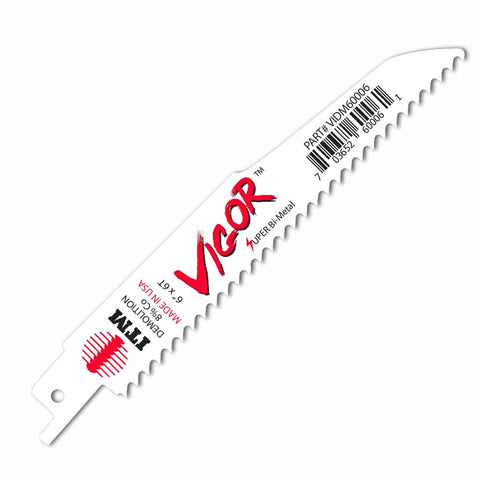
| Nail-embedded wood, remodel tear-out | 6 | Demolition | .062 in. | DM606, DM906, DM1206 |
| Mixed demolition: wood, nails, bolts, thin metal | 10 | Demolition | .062 in. | DM610, DM910, DM1210 |
| PVC and ABS plastic pipe | 10 | Metal | .035 in. | M610, M810, M1010 |
| Sheet metal, EMT conduit, thin tubing (under 1/8 in.) | 18–24 | Metal | .035 in. | M618, M624, M418, M424 |
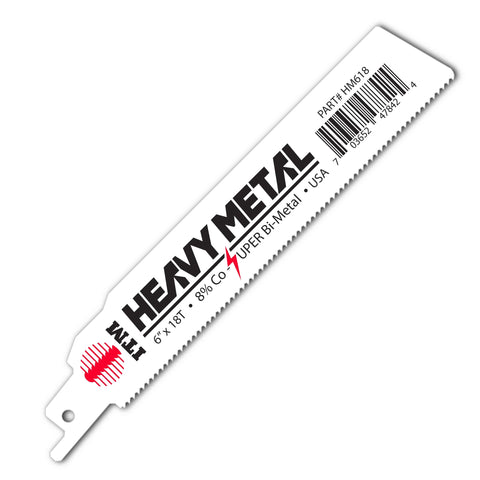
| Steel pipe, angle iron, threaded rod | 24 up to 2-in. pipe, 14 for 3–6 in. | Metal or Heavy-Metal | .035 or .042 in. | M624, M814, HM614, HM914 |
| Solid bar, thick plate (over 1/4 in.) | 10 | Heavy-Metal | .042 in. | HM610, HM910 |
| Metal of unknown or changing thickness | 10/14 variable pitch | Heavy-Duty | .050 in. | HD610, HD810, HD120 |
| Cast iron pipe, rebar, abrasive material | 8 (carbide) | MaxMetal Carbide | .050 in. | CT6, CT9 |
All of these blades are made in the USA by ITM. They have bi-metal teeth with 8% cobalt, hardened to Rc 65–67, except the MaxMetal line, which has carbide teeth. Browse every size in our reciprocating saw blade collection.
What does TPI mean, and how many teeth should a blade have?
TPI is teeth per inch. The rule is to keep at least three teeth in the material at all times. With fewer than three, each tooth takes too big a bite, so teeth snag and snap off. With far more than you need, chips clog the gaps between teeth in thick wood and the cut slows down.
To check a blade, multiply the material thickness by the TPI. A 1/8-in. wall times 24 TPI puts 3 teeth in the cut.
Pipe: measure the wall, not the pipe
For pipe, the wall thickness sets the TPI and the outside diameter sets the length. These are standard Schedule 40 steel pipe sizes from ASME B36.10.
| Pipe size | Outside diameter | Wall | TPI for 3 teeth | Blade length |
|---|---|---|---|---|
| 1/2 in. | 0.840 in. | 0.109 in. | 24 TPI (2.6 teeth) | 4 in. |
| 3/4 in. | 1.050 in. | 0.113 in. | 24 TPI (2.7 teeth) | 6 in. |
| 1 in. | 1.315 in. | 0.133 in. | 24 TPI (3.2 teeth) | 6 in. |
| 1-1/2 in. | 1.900 in. | 0.145 in. | 24 TPI (3.5 teeth) | 6 in. |
| 2 in. | 2.375 in. | 0.154 in. | 24 TPI (3.7 teeth) | 6 in. |
| 3 in. | 3.500 in. | 0.216 in. | 14 TPI (3.0 teeth) | 8 in. |
| 4 in. | 4.500 in. | 0.237 in. | 14 TPI (3.3 teeth) | 8 in. |
| 6 in. | 6.625 in. | 0.280 in. | 14 TPI (3.9 teeth) | 10 in. |
On thin-wall pipe, tilt the saw so the blade enters at a shallow angle. That puts more teeth in contact and stops the blade from grabbing.
A variable pitch (VP) blade, such as a 10/14, mixes two tooth spacings on one blade. It is the easy choice when the wall thickness changes during the cut, and the uneven spacing cuts vibration. The FAQ below explains how it works.
What length reciprocating saw blade do I need?
Pick a blade at least 3 inches longer than the thickest material or the widest pipe you are cutting. Most saws move the blade 1 to 1-1/4 in. per stroke. The tip needs to stay past the far side of the work, with room to spare behind the shoe.
- 4–6 in.: tight spaces, sheet metal, conduit and small pipe. Short blades wobble less.
- 8–9 in.: general demolition, 2x lumber and pipe up to about 4 in.
- 10–12 in.: thick beams, tree limbs, large pipe, and flush cuts where the blade needs to flex.
Longer is not always better. An extra-long blade bends and wanders on a short cut, so buy the shortest blade that clears the work.
How thick should a reciprocating saw blade be?
Thicker blades bend less, and thinner blades flex for flush cuts. Standard metal blades are about .035 in. thick. Demolition blades are .062 in., about 1.8 times as thick, which is why they survive nails and prying.
| Blade family | Height × length × thickness | Best for |
|---|---|---|
| Metal | 3/4 × 4–12 × .035 in. | Clean metal cuts, flush cutting, tight spots |
| Heavy-Metal | 1 × 6–12 × .042 in. | Long or heavy metal cuts. The taller body tracks straighter. |
| Heavy-Duty variable pitch | 3/4 × 6–12 × .050 in. | One blade for mixed metal jobs |
| Wood & Nail | 3/4 × 6–12 × .050 in. | Wood, including hidden nails |
| MaxMetal Carbide | 1 × 6–9 × .050 in. | Cast iron, rebar and abrasives |
| Demolition | 7/8 × 6–12 × .062 in. | Tear-out, prying and nail-embedded wood |
Bi-metal or carbide: when is a carbide blade worth it?
Buy carbide when you cut cast iron, rebar or anything abrasive more than once in a while. A carbide blade costs more per blade. But it lasts many times longer in material that wears bi-metal teeth down in a few cuts.
| 6-in. blade | Pack | Pack price | Per blade |
|---|---|---|---|
| Metal 14T (M614) | 5 | $11.07 | $2.21 |
| Wood & Nail 6T (W636) | 5 | $15.36 | $3.07 |
| Heavy-Duty 10/14T (HD610) | 5 | $17.88 | $3.58 |
| Heavy-Metal 14T (HM614) | 5 | $20.76 | $4.15 |
| Demolition 6T (DM606) | 3 | $17.05 | $5.68 |
| MaxMetal Carbide (CT6) | 5 | $73.45 | $14.69 |
Store prices on Sept 27, 2026. Bulk packs of 25 or 50 cost less per blade.
A carbide blade costs about 3.5 times as much as a Heavy-Metal blade. If it makes more than 3.5 times as many cuts in your material, it is the cheaper blade. ITM rates its carbide recips to outlast standard blades by up to 50 times.
"Carbide recips are noticeably smoother and less violent. I get upwards of three dozen heavy-duty cuts out of one blade. They last a lot longer than anything without carbide."
David Castro, President, Eldorado Tools
At three dozen cuts per carbide blade and today's prices, a Heavy-Metal blade has to last about 10 heavy-duty cuts to be the cheaper choice. If yours dies sooner, carbide saves money. It is also easier on your arms.

Will these blades fit my saw, and how do I change the blade?
Yes, if your saw takes a 1/2-in. universal shank. Nearly every corded and cordless reciprocating saw does, including DeWalt, Milwaukee Sawzall, Makita, Ryobi, Bosch, Ridgid and Craftsman. All of our reciprocating saw blades use the 1/2-in. universal shank.
- Remove the battery or unplug the saw.
- Twist the blade clamp collar, or flip the lever on newer saws, and pull the old blade out.
- Push the new blade's shank all the way in, teeth facing down for normal cuts. Face them up to cut close to a floor or ceiling.
- Let the clamp snap back, then tug the blade to make sure it is locked.
How do I make a reciprocating saw blade last longer?
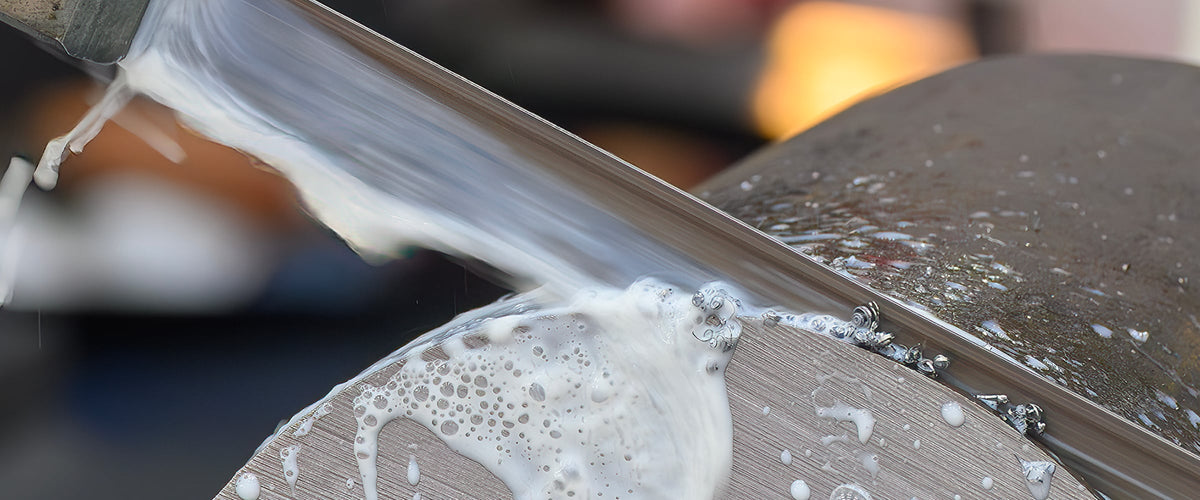
Most blades die from heat, not wear. Slow the saw down for metal, let the weight of the saw do the feeding, and use the whole length of the blade. Our guide to speed and overheating in cutting tools explains why heat ruins teeth.
- Slow down for metal. Run high speed for wood and about half speed for steel. Fast strokes in steel overheat the teeth and turn them blue.
- Turn orbital action off for metal. Orbital mode speeds up wood cuts but chips teeth in steel.
- Keep the shoe tight to the work. A gap lets the saw hammer the blade and snap teeth.
- Do not force it. Pushing hard bends the blade and slows the cut.
- Use cutting oil on metal. A few drops cut heat and friction. On sappy wood, a wax stick stops binding.
- Rock the saw slightly. Changing the angle spreads wear across more teeth.
- Replace bent or chipped blades. A blade missing teeth tears the cut and can bind.
Troubleshooting
| Problem | Likely cause | Fix |
|---|---|---|
| Blade bends or wanders | Blade too thin or too long, or too much push | Step up to Heavy-Metal (.042 in.) or Demolition (.062 in.), use a shorter blade, and let the saw feed itself |
| Teeth strip off | Fewer than three teeth in the material, or orbital on in metal | Use a higher TPI (see the pipe table) and turn orbital off |
| Blade turns blue or smokes | Speed too high for metal | Drop to about half speed and add cutting oil |
| Saw jumps or kicks | Shoe not against the work | Press the shoe flat before you pull the trigger, and keep it there |
| Slow cut with a new blade | TPI too high for thick material, so chips clog | Use a lower TPI, such as 6 for wood or 10 for thick steel |
Reciprocating saw safety basics
Wear safety glasses, gloves and hearing protection. Clamp the work, and check walls for wiring and pipes before a blind cut.
- Unplug or remove the battery before you change blades.
- Blades are hot after a metal cut. Let them cool or wear gloves.
- Keep both hands on the saw, and keep your body out of the blade's path in case it kicks.
FAQ
What sawzall blade should I use for PVC?
Use a 10 TPI metal blade such as the M610. It cuts PVC and ABS fast and leaves a cleaner edge than a 6 TPI wood blade. Pick a length 3 in. longer than the pipe's outside diameter.
What does variable pitch (VP) mean on a saw blade?
Variable pitch means the spacing between teeth changes along the blade. A 10/14 VP blade has stretches at 10 teeth per inch and stretches at 14, instead of one even spacing. Evenly spaced teeth strike the metal in a steady rhythm that can set the blade vibrating. Uneven spacing breaks up that rhythm. The result is less vibration and noise, fewer stripped teeth, and a smoother, faster cut. The bigger gaps clear chips and carry heat out, and the finer teeth keep enough teeth in thin walls. Common VP blades are 10/14 for general metal and 14/18 for thinner metal. Ours are the 10/14 Heavy-Duty blades (HD610, HD810 and HD120). Pick VP when the thickness changes during the cut, as in pipe, tubing and angle iron.
What sawzall blade cuts cast iron pipe?
A carbide-tooth blade such as the MaxMetal CT6 or CT9. Bi-metal blades will cut cast iron but wear out in a few cuts. For 4-in. cast iron, which is about 4.3–4.4 in. across depending on the pipe type, use the 9-in. CT9.
What blade cuts fiberglass?
Fiberglass is abrasive, so it dulls bi-metal teeth quickly. For occasional cuts, a 14–18 TPI metal blade works. For regular work, carbide lasts much longer.
What is the longest reciprocating saw blade?
Common blades run up to 12 in. Our longest are the 12-in. Wood & Nail (W125), Demolition (DM1206 and DM1210), Heavy-Metal (HM1214 and HM1218), Metal (M1218) and Heavy-Duty (HD120) blades.
Can I use a wood blade on metal?
Only in a pinch. A 6 TPI wood blade puts too few teeth in thin metal and will strip. A bi-metal Wood & Nail blade can handle the odd nail, but not sheet metal or pipe.
Where are these blades made?
Our reciprocating saw blades are made in the USA by ITM.
Updated Sept 27, 2026: rewrote this guide with TPI and length rules, a pipe sizing table, blade thickness specs, price per blade, variable pitch and a troubleshooting table. First published May 21, 2023.